Outperform Institute and SkyGeni partner to engineer predictable revenue growth Learn more
Learn more
Private equity board reporting gets harder after a funding round closes. New investors ask for pipeline and forecast visibility at a depth and frequency that most Revenue Operations and Financial Planning and Analysis (FP&A) teams were not built to deliver.
New board members often start by asking how the pipeline actually moved last month, by segment, not just where it stands today. Most companies have the data. What they often lack is the machinery to answer on demand. A team that can show only the pipeline total turns every follow-up question from the board into a test of its credibility.
This blog, part of the Board Reporting After a Raise series, covers what new investors ask and what the Chief Executive Officer (CEO), Chief Financial Officer (CFO) and Chief Revenue Officer (CRO) should set up before the first board package.
The first board meetings after a raise set the reporting standard for the rest of the hold period, and with it the team's credibility. The stakes are higher because private equity returns now rely far more on operating performance than they did in the 2010s. For buyout funds, Bain & Company's Global Private Equity Report 2026 points to borrowing costs of 8 to 9 percent, lower leverage and less help from multiple expansion. By June 2026, Bain's deal cost index was at a record high, and Hugh MacArthur, chairman of Bain's global Private Equity practice, said consistent outperformance will require "the disciplined value creation system to back it up."
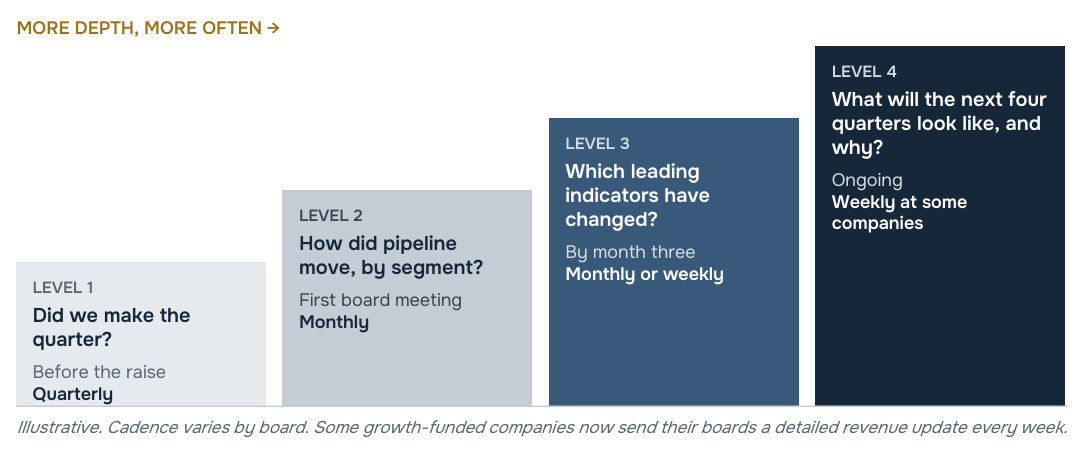
That changed what boards want to see: the drivers of revenue, early and often, not just the revenue at quarter end. After the raise, board questions get deeper and arrive more often.
Sponsors already see a gap. Seventy-four percent of the private equity sponsors Accordion surveyed in 2025 said their portfolio company CFOs were not meeting expectations.
Answering a private equity board's first questions takes pipeline history, shared definitions and live data. Those questions often cover how the pipeline moved last month by segment, whether sales and finance report the same pipeline figure, and which leading indicators have changed.
Illustrative. The last column is an assessment of common starting points, not survey data.
The second question depends on shared definitions that sales, marketing and finance all use, and those need to be settled before the first board package. Board reporting best practices after a fundraise covers how to settle them.
Pipeline history is time-consuming to produce for the board because most CRM systems record only the current state of each opportunity, so teams rebuild it by hand from exports and snapshots. Showing what moved means comparing snapshots from the start and end of the period.
Native history tracking has limits. Salesforce's standard Field History Tracking covers up to 20 fields per object and keeps changes for 18 months in the user interface, or up to 24 months through the Application Programming Interface (API). It records changes only from the date it is turned on.
If the CRM cannot show what an opportunity looked like on a past date, solve that before the first board package. The board will ask for trends, and the day the round closed is the baseline for them.
In the first 100 days, each part of private equity board reporting needs a named owner: the CEO for what the board sees and how often, the CFO for the board package and definitions, and the CRO for pipeline history. If the private equity firm has a 100-day plan, it should set the reporting cadence, shared definitions and pipeline history needed to track the value creation plan.
Ask your team: Could we show the board what our pipeline looked like on the day the round closed, by segment, without rebuilding it by hand?
The Board Reporting After a Raise white paper shows how board questions deepen after the raise, in the first 100 days and across all five stages that follow. It ends with a Readiness Map you can score in 90 seconds to see where your company stands today. Download it before your next board meeting.
Private equity board reporting is how the board tracks progress against the value creation plan. After the close, the funded plan becomes the standard the team is judged against, so each revenue assumption in it, such as win rates or pipeline creation by segment, needs a matching measure in the board package.
Usually monthly, alongside quarterly board meetings, though cadence varies by board. The National Association of Corporate Directors (NACD) 2026 Governance Outlook describes effective private equity boards holding monthly business reviews and using quarterly board meetings for strategic debate.
Much the same as after a buyout: pipeline movement by segment, leading indicators and a multi-quarter forecast built from segment drivers. Growth equity and late-stage venture investors work with different return math than buyout funds, though the pressure on operating results is similar.
SkyGeni is the Explainable AI Revenue De-Risking platform. It helps B2B technology companies identify emerging revenue risks before they impact the forecast, improve conversion efficiency, and deliver more predictable growth.
By connecting pipeline history, segment-level performance, and leading indicators, SkyGeni gives revenue and finance leaders a company-wide view of pipeline movement, growth risks, and revenue projections three to four quarters ahead. Every insight comes with supporting evidence, enabling leadership teams to act earlier and provide the visibility their boards demand.
For a company that has just closed a round, SkyGeni reconstructs the full pipeline at any prior point, including the day the round closed, without CRM snapshots. The five stages after a raise, including the first 100 days covered in this blog, are a SkyGeni framework.
See where your company stands: take the 90-second post-raise readiness assessment.
Join revenue leaders across high-growth B2B companies who are using SkyGeni to spot risk earlier, build better pipeline, and grow predictably.


Empowering revenue teams to plan with precision, execute with confidence, outmaneuver competitors, and expand Lifetime Value. Let’s accelerate predictable revenue growth, together.


