Outperform Institute and SkyGeni partner to engineer predictable revenue growth Learn more
Learn more
RevOps best practices are the operating habits, processes, and systems that help revenue teams work from consistent data, coordinate across functions, and make better decisions.
Consider an illustrative example, not client data. In week 3 of a 13-week quarter, mid-market conversion falls from 30 percent to 20 percent. By week 4, the decline shows up on the weekly dashboard as one line among 40 metrics.
By week 6, quarterly business review (QBR) preparation is still focused on reconciling the numbers, because sales and marketing define qualified deals differently.
The issue is finally escalated in week 8, when the CRO reallocates budget and sellers toward the segment.
But with only five weeks left in the quarter and a typical mid-market sales cycle of 60 days, there is no longer enough time for the intervention to change the quarter.
The signal was visible four weeks before meaningful action was taken. That is the blind spot.
The problem is not that RevOps failed to produce the data. It is that the data did not become a decision quickly enough.
In practice, that gap is decision velocity: the time between a meaningful change in the business and action by someone with the context and authority to respond.
This article covers the third blind spot in SkyGeni's Revenue Execution Blind Spots Series, based on our brief, The Five Revenue Execution Blind Spots.
Our article on sales forecast accuracy showed that early visibility buys time. This one looks at what happens to it.
RevOps best practices are the operating habits that keep revenue teams aligned on the same numbers and help them act on those numbers consistently.
Revenue Operations (RevOps) is the function that brings together the data, systems, and processes behind a company’s revenue operations.
Its role is to help sales, marketing, customer success, and other revenue teams work from the same information and toward the same business goals.
The visible symptom is not a lack of data or reporting. It is that too much analytical capacity gets spent producing material that describes the business, while too little is focused on helping leaders decide what to do next. The result is slower decision-making.
In practice, RevOps often spends a significant amount of time producing board decks, preparing QBR packs, responding to one-off reporting requests, and reconciling numbers across teams.
Each of these requests is reasonable on its own. The problem is what happens when they consume most of the function’s analytical capacity.
RevOps gradually becomes a reporting function, measured by how well it explains the business rather than how effectively it helps leaders act on what is changing.
Clean data, shared dashboards, and standardized reporting are important foundations, but they do not automatically lead to better decisions.
Across the B2B revenue teams we have worked with, the signals behind repeated revenue misses were often already present in the data.
The challenge was seeing them at the right level of detail, in the right context, and early enough to act.
Eighty-four percent of the 303 sales leaders Gartner surveyed in July 2023 agreed that sales analytics has had less influence on sales performance than leadership expected. That is a gap between what leadership expected from analytics and what it got.
When Gartner asked those leaders what stands in the way, the top three barriers were data privacy concerns or regulations (45 percent), poor data quality (44 percent), and limited cross-functional collaboration (44 percent).
None of the three is a shortage of models or dashboards. Two of them, data quality and cross-functional collaboration, come down to whether the functions trust the same numbers and work from them together. Buying a more sophisticated model does not fix either one.
The same Gartner survey found that analytics led by the chief sales officer (CSO) is 2.3 times more likely to achieve higher forecast accuracy than analytics that are not CSO-led. Gartner reports this as an association.
For revenue leaders, the implication is that when the sales leader owns the analytics agenda, the analytics gets pointed at the decisions the sales leader actually has to make.
Gartner's own recommendation is along the same lines. It suggests CSOs prioritize the analytics that influence the decisions with the greatest impact.
THE INSIGHT: The real cost of a reporting-centered RevOps function is measured in weeks, not analyst hours. It is decision velocity: the interval between a condition changing in the business and someone with authority acting on it.
Decision velocity is the interval between a meaningful change in the business and action by someone with the context and authority to act. The shorter the interval, the higher the decision velocity. Faster is not the goal. The aim is a sound decision, by the right owner, on trusted numbers, while it can still change the outcome.
The interval covers three steps: the change reaches the decision owner, the decision is made, and action starts. Reporting-centered RevOps slows the first two: the change arrives late, buried in a report, and the decision waits on reconciled numbers.
The longer the interval, the less time the organization has to intervene before the change affects revenue.
Detection Horizon, covered in Sales Forecast Accuracy: Why Revenue Risk Is Seen Only After the Forecast Breaks, is SkyGeni's measure of warning time: the quarters between a deviation surfacing in your data and leadership seeing it.
Both measures start from the same change in the data. Detection Horizon asks how early the warning arrives, and decision velocity asks how much of it becomes action. A risk seen early can still be acted on too late.
Turning reporting into decisions requires RevOps to do more than make data available. The goal is to reduce the time spent reconciling numbers, producing recurring reports, and figuring out what matters, so leaders can focus on what changed and what to do next.
The first three practices come directly from the recommendations for Blind Spot #3 in our white paper. The fourth extends the same decision-centered principle into an operating practice, while the fifth builds on Gartner’s research on leadership-led analytics.
Settle metric definitions once, not in every meeting. One governed source of truth is the precondition for cross-functional decisions.
If sales, marketing, and finance enter every QBR with different definitions of pipeline, qualified leads, or conversion, the meeting starts with reconciliation rather than action. Define the metrics, assign ownership, and govern changes so teams can spend their time deciding what the numbers mean for the business.
Gartner found that 49 percent of CSOs say their definition of a qualified lead differs greatly from marketing's.
Automate recurring reporting so RevOps can spend more analytical capacity on understanding why the business changed.
Board decks, QBR packs, and recurring dashboards should not consume the time that could be spent diagnosing changes in conversion, pipeline, or sales cycles. If a QBR pack takes a week to build, generate as much of it as possible from live data and use that week to investigate the segments that moved.
The report should surface the change. RevOps should help explain it. The decision itself remains with the leader who owns the outcome.
If nobody can state how long it takes to act on a change in conditions, that interval is longer than you think.
For the last five material changes, record when the change first appeared in the data, when it reached the relevant decision owner, when a decision was made, and when action began.
Those intervals show where time is being lost. A signal may be detected quickly but sit in a dashboard for two weeks.
A leader may see the issue but spend another week reconciling numbers across functions. Tracking these gaps turns decision velocity into a revenue operations metric that RevOps can actively improve.
Before building or maintaining a report, identify the decision it is intended to support and who owns that decision.
Ask of every recurring report:
What decision is this supposed to help someone make?
If the answer is unclear, the report may be describing the business without helping change it.
Starting with the decision forces RevOps to build reporting around the questions leaders actually need answered, rather than around the data that happens to be available.
The analytics agenda should start with the decisions sales leadership needs to make, with RevOps building the analysis needed to support them.
Instead of RevOps deciding which dashboards or analyses leaders should review, leadership identifies the critical questions for the quarter. For example: Where is conversion deteriorating?
Which segment needs more pipeline? Where should capacity be reallocated? Which risk requires intervention now?
RevOps then brings together the data and diagnosis needed to answer those questions. This keeps analytics connected to the decisions that can actually change the outcome.
ASK YOUR TEAM: What share of our last quarterly business review was spent agreeing on the numbers rather than deciding what to do about them?
Our series overview compared reporting with decision intelligence. Here, the focus is on how RevOps operates to turn insight into action.
EXECUTIVE TAKEAWAY: When review time goes to reconciling numbers, start with metric governance before adding analytical capacity.
SkyGeni’s Revenue Execution Chain shows how predictable revenue depends on a series of connected operating links, from strategy and pipeline quality through revenue visibility, decision-making, customer expansion, and continuous improvement. Each link affects what happens next.
Within that chain, operational decision-making comes after revenue visibility and before customer expansion. Its role is to turn what the organization can see into action.
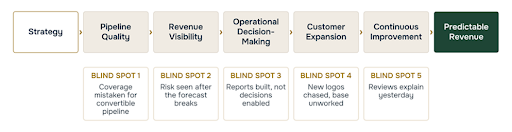
Our previous article focused on when a revenue signal becomes visible to leadership and how leading indicators can surface risk before it reaches the forecast. This blind spot starts at the next step: what happens after the signal is visible.
Revenue risk detection helps leaders see a problem earlier. It does not guarantee that the organization will act on it quickly enough.
That is why a slow decision process rarely appears as a decision problem. It surfaces later as a missed number, a pull-forward, or heavier discounting, often after the window to reallocate capacity or change course has narrowed.
As revenue execution matures, organizations move from fragmented metrics to faster, more consistent decision-making. SkyGeni’s Revenue Execution Benchmark Map captures this progression through Commercial Coherence.
At the Anticipatory level, leadership not only agrees on the numbers but also knows how long it takes to turn a signal into action and works to reduce that time.
A common one is judging RevOps by the reports it produces rather than by the decisions those reports enable.
RevOps helps address disconnected data, inconsistent processes, and misaligned targets. Done well, it also shortens the time to act.
Sales operations supports the sales team: territories, quotas, forecasting, and the CRM. RevOps covers the full revenue process across marketing, sales, customer success, and finance.
Coverage mistaken for convertible pipeline, risk seen only after the forecast breaks, reports built instead of decisions enabled, new logos chased while the installed base goes unworked, and reviews that explain yesterday.
The best RevOps practices are judged by what they change. The useful test is how quickly a meaningful change in the business reaches someone with the context and authority to act.
That is the third Revenue Execution Blind Spot, and like the others, it is not a forecasting problem. Next in the series: new logos chased while the installed base goes unworked.
Each article in the series, based on our brief The Five Revenue Execution Blind Spots, covers one blind spot. Start with Revenue Forecasting: The Five Blind Spots.
SkyGeni helps B2B revenue leaders identify execution risks before they become forecast misses. Our approach to Revenue De-Risking starts from a simple conviction: the signals that determine future revenue often already exist in your data. We connect them across pipeline, conversion, and customer expansion so leaders can act early.
Join revenue leaders across high-growth B2B companies who are using SkyGeni to spot risk earlier, build better pipeline, and grow predictably.


Empowering revenue teams to plan with precision, execute with confidence, outmaneuver competitors, and expand Lifetime Value. Let’s accelerate predictable revenue growth, together.


