Outperform Institute and SkyGeni partner to engineer predictable revenue growth Learn more
Learn more
Revenue forecasting estimates the revenue a company will generate in a period from its recurring base, pipeline, conversion rates and sales cycles. When a forecast misses, the forecast is rarely the cause. The cause is usually one or more of five revenue execution blind spots, visible in a company’s own data one to three quarters before the forecast changes.
Forecasting is one of the most critical operating processes inside modern revenue organizations. Every quarter, CROs, CFOs, and RevOps leaders review pipeline, update forecasts, debate commit numbers, and evaluate whether the business is on track to achieve its targets.
Despite all this, revenue forecasts still miss. When this happens, organizations respond by tightening deal reviews and increasing the scrutiny of the forecast, only to see the forecast miss again.
The revenue forecast often gets blamed for the lack of predictable revenue outcomes.
In most cases, the forecast is not the problem. Predictable revenue is the output of a connected revenue execution chain. The revenue forecast is just the final link in that chain.
The deviations that cause revenue misses are visible one, two, sometimes three quarters earlier in the data companies already have. Pipeline quality changes, conversion rates decline, sales cycles extend, and execution risks emerge long before they appear in the forecast.
The revenue forecast is like a thermometer.
When the quarter runs a fever, arguing with the thermometer does not change the outcome.
The thermometer tells you something is wrong. It does not tell you why the fever exists or what conditions created the problem.
Revenue misses are often misdiagnosed as forecasting problems and are often caused by the following five revenue execution blind spots:
None of these is a forecasting problem. Leaders need visibility to emerging risks in all links of the connected revenue execution chain while there is still time to act.
Revenue forecasting is the process of estimating future revenue using historical performance, pipeline data, conversion rates, sales cycle patterns, and business assumptions.
Organizations use revenue forecasting to answer:
“Based on what we know today, what revenue outcome should we expect?”
Traditional forecasting relies on inputs such as:
These inputs matter. But the accuracy of a forecast depends on the quality of the revenue execution signals behind them.
A forecast can only reflect what an organization can see.
If revenue risk is hidden inside pipeline quality, competitor behavior, or efficiency breakdowns, even the best forecasting models may identify the problem only after the opportunity to change the outcome has significantly narrowed.
Most revenue teams use two or three of the methods below. Each one is useful. Each one also has a blind spot, because a forecast can only reflect the inputs it is given.
| Method | How it works | What it relies on | What it can miss |
|---|---|---|---|
| Pipeline-based (weighted pipeline) | Multiplies each open deal's value by the win rate for its stage | Stage data and close dates in the CRM | Coverage that cannot convert in time (Blind Spot 1) |
| Bottom-up (seller roll-up) | Sellers and managers call the deals they expect to close | Seller judgment | Risk that sellers have not yet seen or reported (Blind Spot 2) |
| Historical (time series) | Projects revenue from past patterns and seasonality | A stable past | Shifts in conversion or cycle time in one segment (Blind Spot 2) |
| Top-down | Starts from targets, market size or a growth rate | Plan assumptions | Whether each segment has enough pipeline to deliver its share (Blind Spot 1) |
| Expansion and retention | Forecasts renewals, upsell and churn in the installed base | Renewal dates, usage and account history | Expansion potential nobody has ranked (Blind Spot 4) |
| AI and machine learning models | Learn patterns from many past deals and signals | Clean, consistent historical data | Why the number is moving and what to change, unless the model explains its drivers (Blind Spots 3 and 5) |
Better methods help, but no method can show a risk that is not in its inputs. That is why revenue misses are so often misdiagnosed as forecasting problems.
Many companies misdiagnose revenue misses as forecasting problems, and respond by improving the forecasting process.
They add:
But revenue forecasts are a lagging indicator. By the time the forecast changes, the conditions behind that change have usually been in place for some time:
The question is not only:
“How accurately can we predict revenue?”
The more important question is:
“How early can we identify the conditions that will determine revenue, and what actions can still change the outcome?”
This is why many revenue forecasting challenges are actually revenue execution challenges.
A forecasting model can predict an outcome. It cannot automatically identify the execution gaps creating that outcome.
Reliable revenue forecasting requires more than knowing what is likely to happen.
It requires understanding why it is happening and whether leaders still have time to change it.
This is the gap between revenue forecasting and revenue execution.
Revenue Forecasting and Revenue Execution answer different questions.
| Revenue Forecasting | Revenue Execution |
|---|---|
| What revenue will we achieve? | Are the conditions in place to achieve it? |
| Measures expected outcomes | Measures the execution system producing outcomes |
| Focuses on prediction accuracy | Focuses on visibility and action |
| Explains what happened | Helps determine what should change |
Revenue forecasting measures the destination. Revenue execution explains whether the organization is still on the path to reach it.
Improving forecast accuracy alone is insufficient. Leaders need visibility into the execution conditions influencing whether the forecast becomes reality.
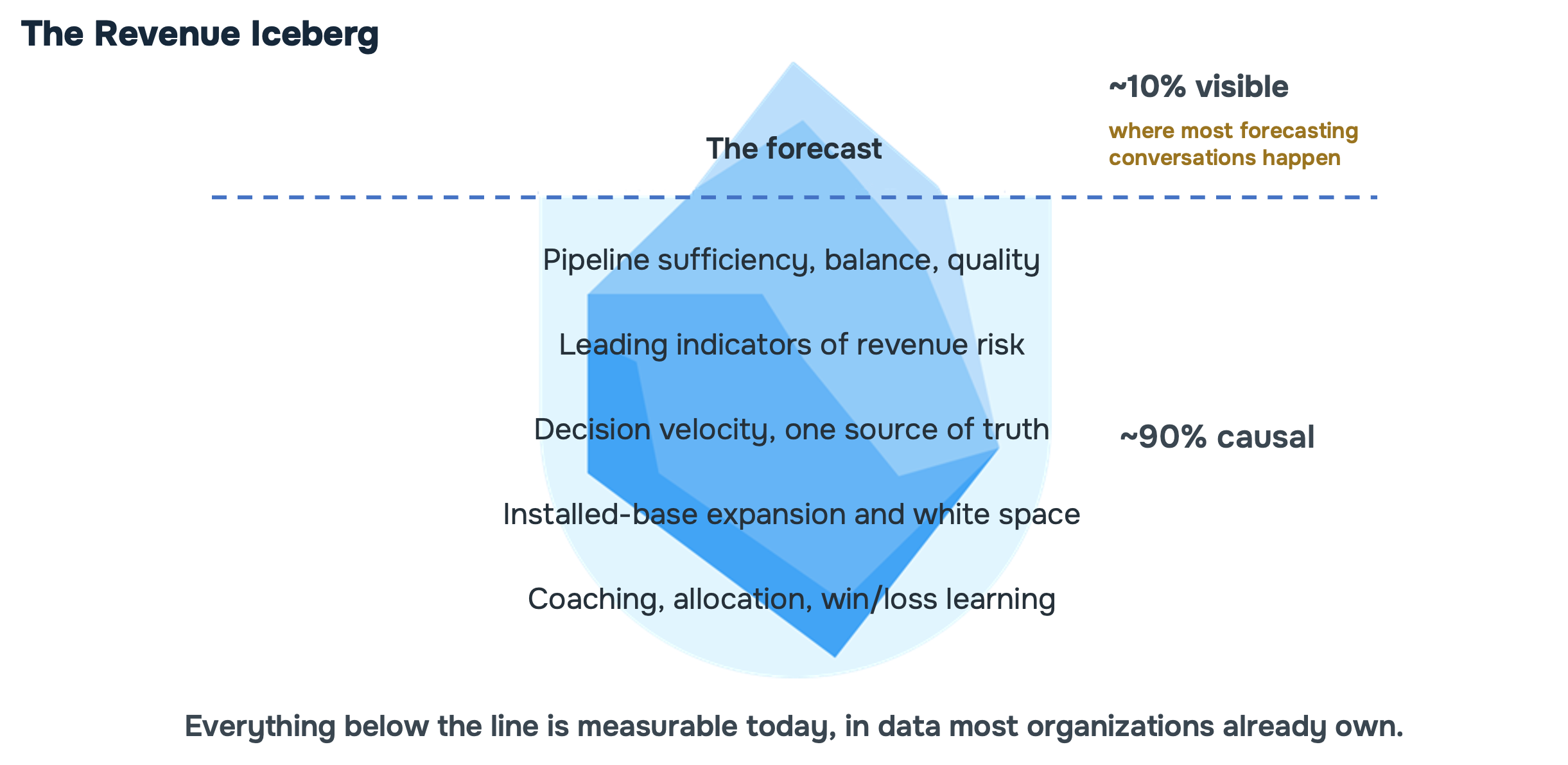
The forecast is what leaders see. The execution conditions creating that forecast are often hidden below the surface.
The visible outcome represents only a portion of the revenue system. The majority of factors influencing future revenue exist below the surface. This is why trying to improve the forecasting process alone cannot create predictable revenue.
Organizations must understand and improve the execution conditions driving the forecast.
Revenue intelligence and revenue execution are often used as if they mean the same thing. They answer different questions.
| Comparison point | Revenue Intelligence | Revenue Execution |
|---|---|---|
| Primary question | What is happening in our deals and pipeline? | Are the conditions in place to hit the number, and what should change? |
| Typical focus | Deal activity, call insights and forecast roll-ups | Pipeline sufficiency, conversion, decisions, expansion and reviews |
| Level of analysis | Individual deals and sellers | Segments, sales motions and the links between them |
| Main output | Insight into the deal in front of you | Earlier warning and the action to take |
Revenue intelligence works like a microscope on the deal in front of you. Revenue execution needs a pair of binoculars: a view of the risks forming two or three quarters out.
Predictable revenue is the output of a connected revenue execution chain of which the revenue forecast is just the last link.
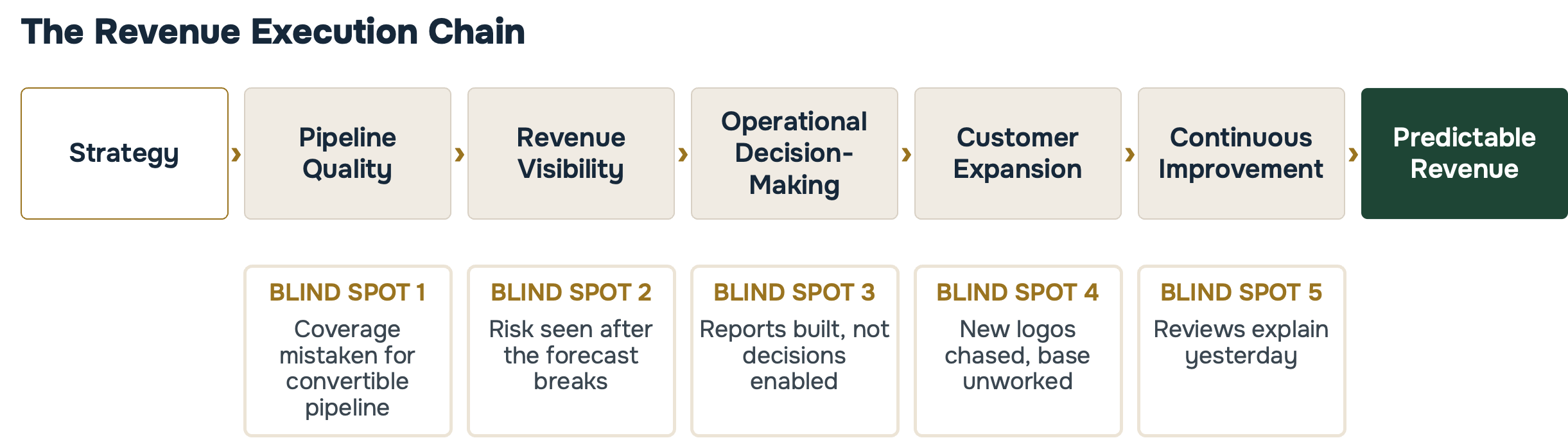
Each link influences the next.
A pipeline quality issue today can become a forecast miss tomorrow. A visibility problem today can become a decision problem later. An expansion blind spot today can become a growth gap in the future.
The forecast is the final link in the chain. It is not the entire system.
Revenue forecasting and revenue execution are complementary, not competing approaches. Forecasting estimates the expected outcome. Revenue execution focuses on the system and timely decisions producing that outcome, helping leaders spot risks while they can be acted upon.
Revenue predictability is the result of doing both well: understanding where revenue is heading while identifying execution risk early enough to influence the outcome.
Revenue forecasting and revenue predictability are connected, but they answer different questions.
| Comparison point | Revenue Forecasting | Revenue Predictability |
|---|---|---|
| Primary purpose | Estimate future revenue | Create greater consistency in revenue outcomes |
| Core question | What revenue outcome should we expect? | How confidently can we anticipate and influence that outcome? |
| Primary focus | Expected revenue | Conditions producing revenue |
| Time orientation | Looks forward from current pipeline and assumptions | Identifies and manages execution conditions before they affect results |
| Measure of effectiveness | Forecast accuracy | Earlier risk visibility and greater consistency of outcomes |
A revenue forecast can tell you a miss is imminent. Revenue predictability helps you spot the emerging risks that will cause a miss while you have time to change the outcome.
This is where the Revenue Execution Chain and Detection Horizon become important. The stronger the organization's ability to detect and address execution risk upstream, the greater its ability to create predictable revenue rather than simply forecast the eventual outcome.
Revenue misses are often caused by the following five revenue execution blind spots, and none of these is a forecasting problem:
Many organizations measure pipeline coverage:
“Do we have enough pipeline?”
But coverage alone does not answer the more important question:
“Can this pipeline realistically convert?”
A company can have strong overall coverage while individual segments lack enough qualified opportunities, conversion potential, or remaining selling time to achieve the target.
| Comparison point | Pipeline Coverage | Pipeline Sufficiency |
|---|---|---|
| Primary question | How much pipeline do we have? | Do we have enough convertible pipeline to hit the target? |
| Focus | Pipeline quantity | Conversion potential |
| Level of analysis | Often aggregate | Segment-specific |
| Key inputs | Pipeline value and target | Win rates, cycle time, deal quality, and time remaining |
| What it reveals | Whether coverage appears adequate | Whether the pipeline can realistically produce the required revenue |
Most organizations discover revenue risk only when the forecast is impacted. By then, intervention options are often limited.
The signals are usually visible months or quarters earlier in data companies already have:
The challenge is not a lack of data. It is detecting the signal early enough.
Detection Horizon: the time between when a revenue deviation appears in internal data and when leadership recognizes the risk.
Revenue risk detection is the practice of spotting the conditions that put future revenue at risk, such as slowing deal progression or falling conversion in one segment, before they show up in the forecast. Detection Horizon measures how early that detection happens.
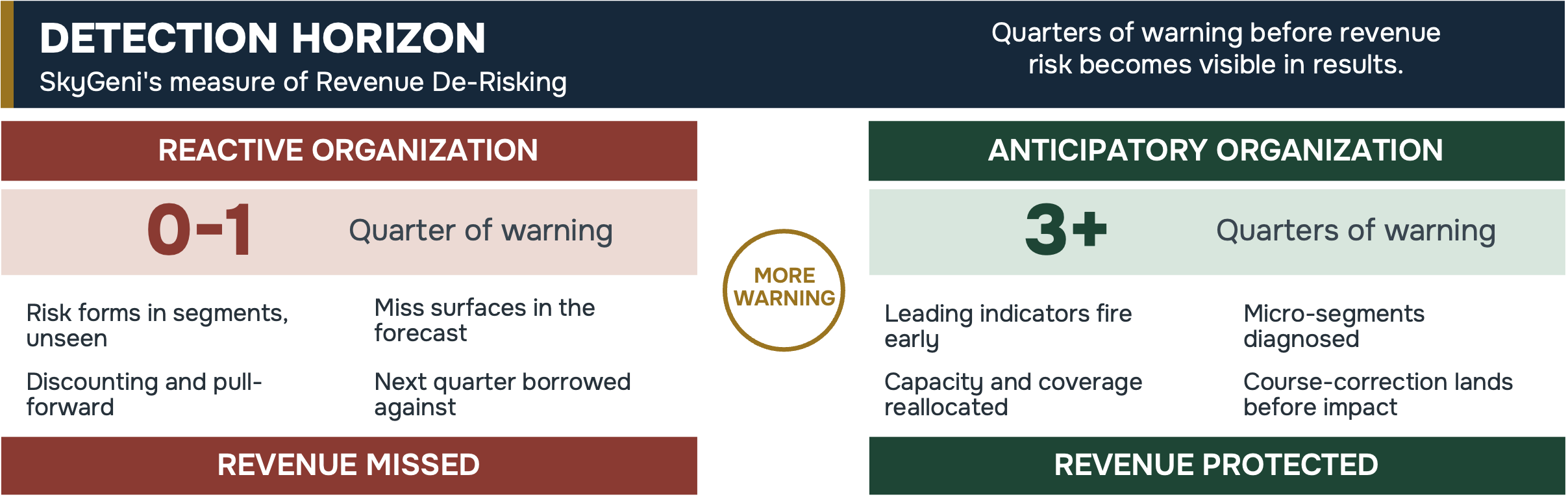
Many organizations have invested in dashboards and analytics. But visibility alone does not create predictable revenue.
According to Gartner, 84% of the sales leaders it surveyed said sales analytics had less influence on sales performance than leadership expected.
Traditional reporting answers:
“What happened?”
Revenue execution needs to go beyond deal intelligence and answer:
“Looking at cohorts of won and lost opportunities, what is changing, why does it matter, and what should we do next?”
Reporting provides visibility into performance. Decision intelligence connects execution signals to the decisions and actions that can improve future outcomes.
| Comparison point | Reporting | Decision Intelligence |
|---|---|---|
| Primary question | What happened? | What is changing, why does it matter, and what should we do? |
| Orientation | Historical | Forward-looking |
| Output | Metrics, dashboards, and reports | Risks, insights, and projected impact |
| Role in decisions | Informs discussion | Supports action |
| Business value | Greater visibility of past performance | Faster, better-informed decisions to shape the future |
Decision intelligence becomes valuable when it connects signals across pipeline, customers, competitive market conditions and execution data to help leaders act earlier.
Our guide to RevOps best practices covers five practices that turn reports into decisions.
Most organizations have strong acquisition visibility.
Expansion is often managed through intuition.
According to McKinsey, growth laggards often struggle with cross-selling because they lack customer insight and personalized strategies, leaving opportunities overlooked.
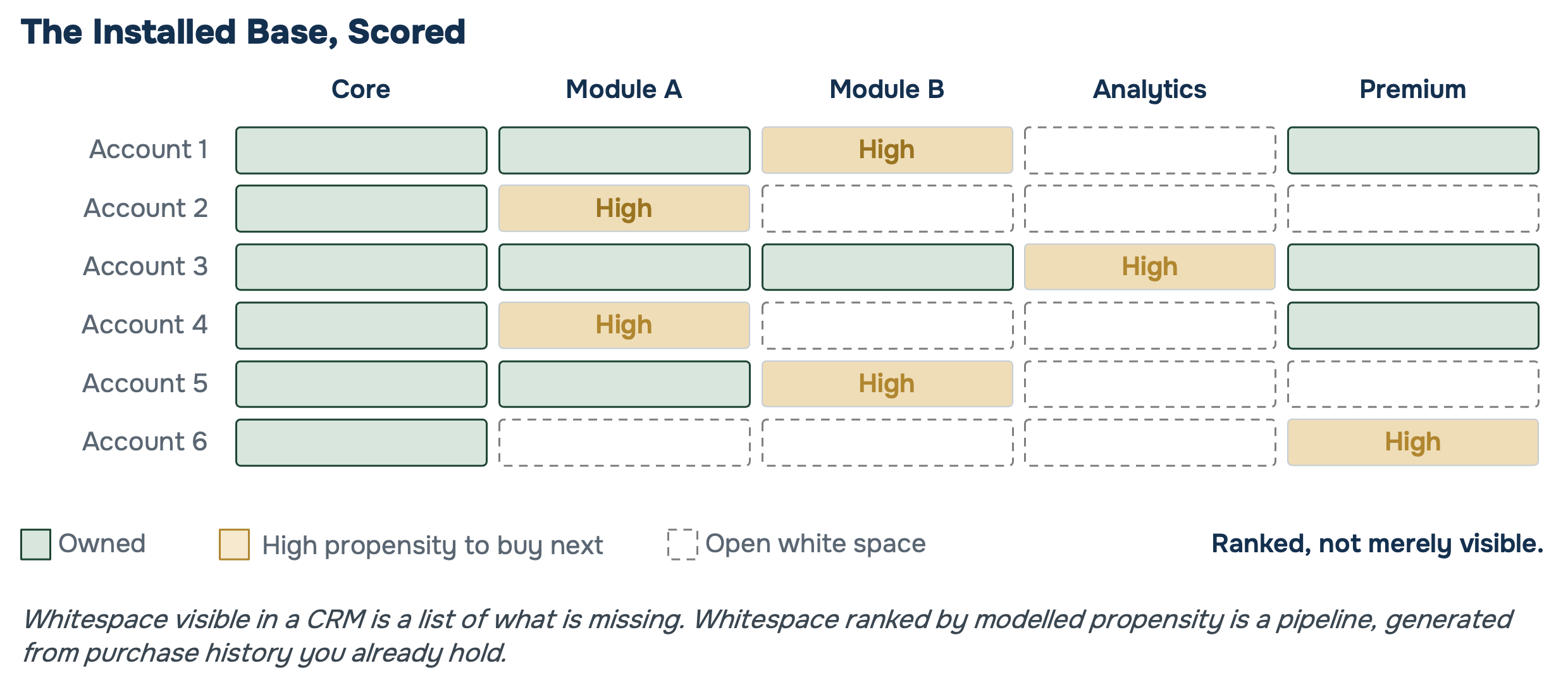
Companies know what customers purchased, but not always what they are most likely to buy next.
Whitespace that cannot be ranked is inventory, not pipeline.
Many business reviews focus on explaining historical outcomes:
But understanding the past does not automatically improve future execution.
A seller missing quota may not have a performance problem.
The real issues could be:
The goal is not better reporting. The goal is better and more timely decisions.
Revenue leaders need to understand the conditions creating outcomes, not only measure the outcomes themselves.
A sound revenue forecast starts with the standard steps and then tests whether the number can actually be delivered. The last two steps are where most forecasts fall short.
For a SaaS business, the first four steps come down to one formula:
Revenue forecast = recurring base + weighted pipeline + expected expansion - expected churn
Consider an illustrative example (not client data):
$8.0M recurring base + $1.2M weighted pipeline + $0.6M expected expansion - $0.4M expected churn = a $9.4M forecast.
Steps 5 and 6 test whether the $9.4M can actually be delivered. If most of the $1.2M of weighted pipeline is in one segment where win rates are falling, the number is at risk long before the forecast shows it.
High-performing organizations do not become predictable by forecasting harder.
They become predictable by improving their ability to see, understand, and act on revenue risks earlier.
This is the foundation of Revenue De-Risking.
Revenue Execution Maturity requires organizations to move beyond measuring outcomes and build visibility into the conditions shaping those outcomes.
Mature revenue organizations:
The objective is not simply to produce a more accurate forecast.
The objective is to create enough visibility and time to influence the outcome.
Forecast blind spots are found by software that looks beyond the forecast itself. CRM forecasting shows what sellers expect to close. Deal intelligence shows activity on individual deals. BI dashboards show the metrics you choose to build. To catch blind spots early, you need software that tracks conversion, cycle time and pipeline creation by segment and explains what is changing.
| Tool category | What it shows | What it can miss |
|---|---|---|
| CRM forecasting and reports | Pipeline by stage, seller commits and forecast roll-ups | Segment-level shifts in conversion and cycle time; risk that sellers have not reported |
| Deal and conversation intelligence | Activity, engagement and risk flags on individual deals | Patterns across segments, and whether there is enough pipeline overall |
| BI dashboards | Any metric the team chooses to build | Questions nobody thought to ask; most dashboards explain the past |
| Revenue execution and de-risking platforms | Conversion, cycle time, pipeline creation and expansion by segment, with the reasons behind changes | Results depend on clean CRM data and consistent stage definitions |
When comparing tools, ask three questions. Does it show risk by segment, not only by deal? Does it explain why a number is changing? How much warning has it given companies like yours?
To go deeper, read our article on sales forecast accuracy or the full brief, The Five Revenue Execution Blind Spots.
Revenue forecasting is the process of estimating future revenue using historical performance, pipeline data, conversion rates, sales cycles, customer trends, and business assumptions.
Organizations use revenue forecasting to understand expected future revenue and support planning, resource allocation, and decision-making.
Start from the recurring base, add weighted pipeline and expected expansion, and subtract expected churn. Then check whether each segment has enough convertible pipeline and how early leading indicators show risk. Those last two checks decide whether the forecast can actually be delivered.
Revenue Execution is the connected system of strategy, pipeline quality, revenue visibility, decision-making, customer expansion, and continuous improvement that creates predictable revenue outcomes.
While revenue forecasting estimates the expected outcome, Revenue Execution focuses on the conditions that determine whether that outcome can be achieved.
Revenue forecasts often fail because execution risks form well before the forecast reflects them, and teams often see them too late to act. Common causes include weak pipeline quality, delayed risk detection, and poor decision visibility.
Detection Horizon measures the time between when a revenue deviation appears in business data and when leadership becomes aware of it.
A longer Detection Horizon gives organizations more time to investigate, make decisions, and influence the outcome before execution gaps become revenue misses.
SkyGeni helps B2B revenue leaders identify the execution risks shaping future revenue before they become forecast misses.
Our approach to revenue de-risking starts from a simple conviction: the signals that determine future revenue often already exist in your data. The challenge is seeing them at the right resolution, in the right context, early enough to act.
SkyGeni connects signals across pipeline, conversion, customer expansion, and sales execution to help CEOs, CROs, Finance, and RevOps teams spot emerging risk, understand what is driving it, and focus action where it can have the greatest impact.
The goal is not simply to forecast the outcome more accurately. It is to give revenue leaders more time to change it.
Join revenue leaders across high-growth B2B companies who are using SkyGeni to spot risk earlier, build better pipeline, and grow predictably.


Empowering revenue teams to plan with precision, execute with confidence, outmaneuver competitors, and expand Lifetime Value. Let’s accelerate predictable revenue growth, together.


