Outperform Institute and SkyGeni partner to engineer predictable revenue growth Learn more
Learn more
Improving sales performance means getting more of the team to hit quota and more predictable revenue from the existing pipeline. Most organizations respond with more pipeline, more coaching, and more reviews. Yet the revenue number often does not move because the review starts with the wrong measure. Attainment measures the outcome well but explains the cause poorly.
A seller at 70 percent of quota may be your best converter, starved of pipeline. Attainment data calls that person an underperformer. Conversion data calls them under-resourced. The two prescriptions could not differ more.
Attainment reads both the same way, even though the right response is the opposite. It compresses the seller, territory, pipeline, process, and market dynamics into one rear-view mirror figure. When that number becomes a verdict, diagnosis becomes a guess. Revenue inconsistency is usually a systems problem, not a talent problem.
This is the last of the five revenue execution blind spots, the series that traces why revenue misses happen despite a healthy pipeline and rigorous forecasting. The fifth blind spot is: sales reviews explain yesterday instead of improving tomorrow.
The problem is not reviewing the past. It is stopping at the result instead of diagnosing why it happened and deciding what should be changed next. For a Chief Revenue Officer (CRO), Chief Executive Officer (CEO), Chief Financial Officer (CFO), or Revenue Operations (RevOps) leader, that distinction decides whether a review merely records the quarter that just closed or improves the next one.
Most sales reviews start with attainment against quota. The problem is that attainment tells leaders where a seller landed, not what caused the result or what should change next.
Most B2B sales organizations run regular sales performance evaluations, often as part of a Quarterly Business Review (QBR) and monthly pipeline reviews. These reviews are one part of sales performance management, the broader discipline of setting quotas, measuring results, coaching sellers, and managing territory and compensation. The core measure in these meetings is attainment against quota.
A seller at or above 100 percent attainment is treated as strong, and a seller well below is treated as a problem to fix or to replace.
Attainment anchors the review for practical reasons. It is easy to pull from the Customer Relationship Management (CRM) system, it is already tied to compensation, and every sales leader understands it without explanation. Those are real advantages, and they are why attainment is unlikely to leave reviews. The question is what the leaders do afterward.
Attainment shows the outcome, but it does not explain what caused it.
Consider two sellers who both close the quarter at 70 percent of quota. One is among the weakest converters on the team. The other is among the strongest converters, but reached only 70 percent because they received too little pipeline to hit quota.
Attainment reads both sellers at 70 percent, even though each situation calls for a different response. This happens because attainment compresses several factors into one figure: the seller, the territory, the pipeline they received, the accounts they were asked to pursue, the process around them, and the market they sold into.
Frank Cespedes of Harvard Business School has argued that sales metrics should separate the seller effect from territory, incentive, market, and process effects (Cespedes, 2021). Most reviews do not make that separation.
When a review treats a combined outcome as a verdict on the seller, the diagnosis becomes a guess.
A better review does not stop at the result. It identifies what caused it. The most useful place to start is conversion efficiency, read alongside the pipeline each seller received.
Conversion efficiency is the rate at which a seller advances and closes the opportunities they are given, measured stage by stage. Pipeline received is the dollar value of the opportunities available to the seller during the period.
When conversion efficiency and pipeline received are read together, they answer questions attainment cannot: did the seller convert well, and did they have enough pipeline to convert?
Attainment is a lagging measure of the quarter, while conversion efficiency and stage movement can reveal the conditions behind that result earlier.
As we covered in the blog on Sales Forecast Accuracy, those earlier signals give leaders more time to act before the quarter closes.
The two measures answer different questions, and a review needs both.
The Seller Diagnostic Matrix plots conversion efficiency against pipeline received. Unlike a sales rep performance scorecard that ranks sellers on outcomes, the matrix is built to separate the causes behind similar attainment.
Placing every seller on those two axes produces four situations, and each situation calls for a different action. The value of the matrix is that it replaces a single ranking by attainment with a diagnosis that points to a specific next step.
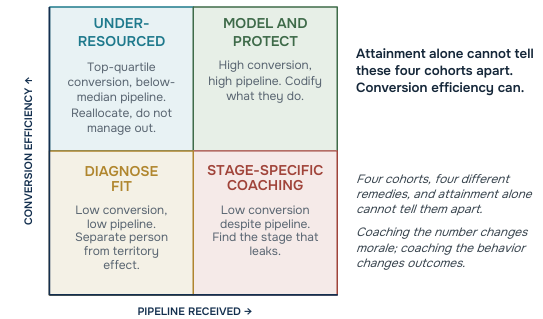
The matrix changes what the review produces. Instead of a ranking followed by general coaching, the meeting produces a specific decision for each seller and moves from describing results to choosing actions. Sales performance coaching becomes more precise as a result.
A seller with enough pipeline but weak conversion needs coaching at the stage where deals stall, while an under-resourced strong converter needs more pipeline rather than the same coaching.
The review shifts from a conversation about quota attainment to a conversation about what caused the result.
To improve sales performance from the review itself, three changes turn a record into a decision.
First, benchmark against your own top performers. Compare each seller’s stage-wise conversion and cycle time with those of the sellers who already convert well in your business, rather than with a broad industry average that hides your own context.
Second, diagnose before you prescribe. A pipeline shortfall, an account-fit problem, and a stage-specific conversion weakness can produce the same attainment number, but each requires a different response.
Third, make reallocation an operating act, not a political event. Pipeline and territory should move toward demonstrated conversion efficiency as a matter of routine, while there is still time to shape the quarter.
Each of these changes starts with information and pipeline the organization already has, rather than assuming that improving performance requires adding more pipeline.
This blind spot maps to the Continuous Improvement link in the Revenue Execution Chain, which runs from strategy through pipeline quality, revenue visibility, operational decision-making, customer expansion, and Continuous Improvement to predictable revenue.
Continuous Improvement is how the organization carries what it learns into the next cycle. When reviews only record the past, that learning does not consistently change coaching, allocation, or other operating decisions.
A review that looks beyond attainment to conversion efficiency and pipeline received can also help extend the Detection Horizon.
Detection Horizon is the time between a revenue deviation surfacing in the organization’s own data and becoming visible to leadership. When reviews consistently identify where conversion is weakening and which sellers are converting well, recurring execution problems can become visible earlier, while there is still time to act. That is the connection to predictable revenue.
A forecast becomes more reliable when the execution feeding it becomes more repeatable, not simply when the forecast itself becomes more precise.
Before the next review, run one check against your own data:
Which sellers have top-quartile conversion efficiency and below-median pipeline, and what has the organization done about them?
If strong converters are still being treated as performance problems rather than as under-resourced sellers, the review is explaining yesterday instead of improving tomorrow.
Reallocating pipeline and territory toward demonstrated conversion efficiency is one way to act on that diagnosis while there is still time to affect the quarter.
Start by separating conversion efficiency from pipeline received. Reallocate pipeline toward sellers who convert well but are under-resourced, and use stage-specific coaching for sellers who have enough pipeline but convert poorly. Both actions improve how the existing pipeline is used.
Do not stop at attainment. A seller can miss quota because they convert poorly, receive too little pipeline, or face issues related to territory, account fit, or process. Reading conversion efficiency alongside pipeline received helps separate the outcome from its likely causes.
Diagnose before you act. Use conversion efficiency and pipeline received to determine whether the seller needs more pipeline, stage-specific coaching, or further diagnosis of fit and territory. The response should match the cause, not simply the attainment number.
Because they often stop at attainment. Attainment shows where a seller finished, but not why they finished there. Without diagnosing the cause, the review explains the past without changing what should happen next.
SkyGeni is the Explainable AI Revenue De-Risking platform for B2B revenue teams. It detects execution risk while there is still time to act on it, rather than after the impact reaches the forecast.
For Sales Performance Reviews, SkyGeni reconstructs the pipeline and analyzes conversion efficiency by seller, stage, industry and segment against their own historical patterns.
SkyGeni classifies each seller into three non-exclusive buckets - High Quota Attainer, High-Potential Rep and Pipeline Burner. A rep can be both a High Quota Attainer and a Pipeline Burner, suggesting that high performance was not necessarily driven by high conversion but by access to a disproportionately large pipeline.
By benchmarking conversion rates by sales stage for each rep against the cohort of top reps in your own organization, SkyGeni identifies weak spots for proactive, targeted intervention.
The automated classification and the benchmarking provide clear recommendations on actions needed for each seller.
This helps leaders distinguish between sellers who need more pipeline, those who need stage-specific coaching, and those who require further diagnosis, so reviews can focus on what to change next rather than only explaining what happened.
Join revenue leaders across high-growth B2B companies who are using SkyGeni to spot risk earlier, build better pipeline, and grow predictably.


Empowering revenue teams to plan with precision, execute with confidence, outmaneuver competitors, and expand Lifetime Value. Let’s accelerate predictable revenue growth, together.


